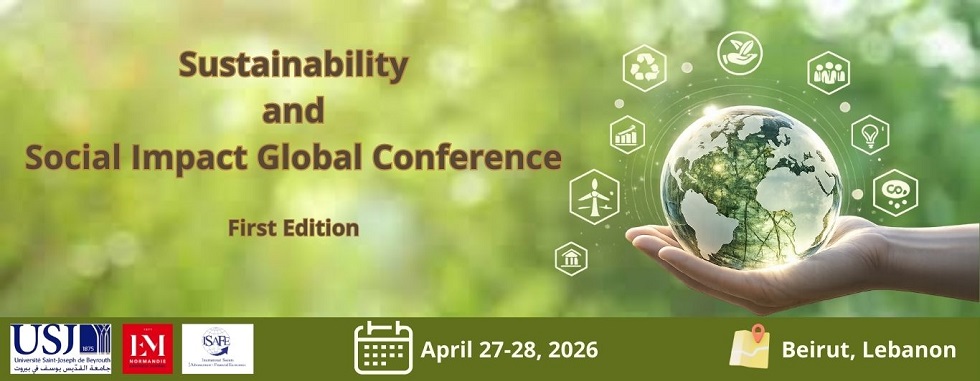
Sustainability and social impact represent a comprehensive approach to development that integrates economic performance, environmental responsibility, and social progress. The Sustainability and Social Impact – Global Conference provides an interdisciplinary platform for scholars, policymakers, and practitioners to critically examine how organizations, markets, and institutions can respond to climate change, inequality, and technological transformation while creating durable social and economic value.
Grounded in the three core dimensions of sustainable development—economic, environmental, and social—the conference promotes dialogue that bridges rigorous academic research with real-world challenges. Particular attention is given to regions undergoing rapid economic, social, and institutional transitions, where sustainability is both an urgent necessity and a strategic opportunity. By bringing together diverse perspectives across business administration disciplines and related fields, the conference aims to advance knowledge, inform policy, and support responsible decision-making in a rapidly changing global context.
KEYNOTE SPEAKERS
Leo Paul Dana, Dalhousie University, Canada
Leo Paul Dana is a Professor at Dalhousie University (Canada) and an internationally recognized scholar in entrepreneurship and small business studies. His research focuses on international entrepreneurship, indigenous entrepreneurship, family business, and entrepreneurship in emerging and transition economies.
Professor Dana has published extensively in leading academic journals and authored numerous influential books. He is known for his global perspective, interdisciplinary approach, and long-standing engagement with entrepreneurial ecosystems across diverse cultural and institutional contexts.
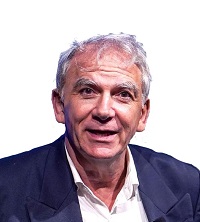
Iftekhar Hasan,Fordham University, United States
Iftekhar Hasan is a University Professor at Fordham University, where he holds the E. Gerald Corrigan Chair in Finance, serves as Academic Director of the Ph.D. program, and co-directs the Center for Research in Contemporary Finance at the Gabelli School of Business. He is also a scientific advisor to the Central Bank of Finland, a fractional faculty member at the University of Sydney, and a research fellow at the Wharton School’s Financial Institutions Center and the IWH Institute in Halle, Germany. He is Managing Editor of the Journal of Financial Stability and has served as associate editor for several leading journals.
He has secured numerous research grants and authored or edited 16 books, along with extensive publications in top journals across finance (JFE, JFQA, RFS, JB), accounting (JAR, RAST, CAR), economics (JME, JIE, JEG, JMCB), international business (JIBS), and management (SMJ, JoM, HRM, RP, JBE). Professor Hasan has held visiting positions worldwide, including in Rome, Strasbourg, Madrid, Lausanne (EPFL), Hong Kong, Taipei, Bucharest, Xi’an, Malaysia, Sydney, and NYU Stern. He has also consulted for international organizations such as the World Bank, IMF, United Nations, Federal Reserve Bank of Atlanta, U.S. Treasury (OCC), Banque de France, Development Bank of Japan, the University of Vaasa, and the Italian Deposit Insurance Corporation.
A Fulbright Scholar and selector, he has received multiple international distinctions, including Changjiang Scholar (China), Louis Bachelier Fellow (France), Shimomura Fellow (Japan), Bursa Malaysia Chair, and a Doctor Honoris Causa from the Romanian American University.
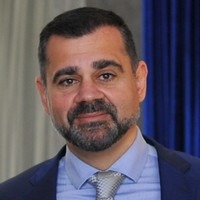
Demetris Vrontis, University of Nicosia, Cyprus.
Professor Demetris Vrontis is the Vice Rector for Faculty and Research and a Professor of Strategic Management at the University of Nicosia, Cyprus. He is the Founding Editor and Editor in Chief of the EuroMed Journal of Business, an Associate Editor of the International Marketing Review, an Associate Editor of the Journal of Strategic Marketing, a Senior Advisor of the International Studies of Management & Organization, a Senior Associate Editor of the FIIB Business Review and an editorial advisory board member in numerous academic and scientific marketing, management and business-related journals. He has a wide editorial experience and has successfully edited over 80 guest editions in top-tier journals. He is the President of the EuroMed Academy of Business and the Managing Director of Gnosis Mediterranean Institute for Management Science, which serve as important and influential regional hubs in the area of Business and Management. He has widely published in over 500 refereed journal articles, 70 books and 90 chapters in books, and he has presented papers at over 100 conferences around the globe. His refereed journal articles appeared in (among others) Human Resource Management (USA); British Journal of Management; Journal of World Business, Journal of Product Innovation Management, Business History, The International Journal of Human Resource Management; Technovation, Journal of Business Research; Journal of International Management; International Marketing Review; Technological Forecasting and Social Change; International Business Review; Industrial Marketing Management; European Management Review; IEEE Transactions on Engineering Management; Human Resource Management Review; Annals of Operations Research, Production Planning and Control, Journal of Sustainable Tourism; Information Systems Frontiers, Accounting, Auditing and Accountability Journal, International Journal of Entrepreneurial Behavior and Research, Asia Pacific Journal of Management and more. He is a fellow member and certified Chartered Marketer of the Chartered Institute of Marketing and a Chartered Business Consultant. He is also currently serving as a consultant and is a member of the board of directors of several international companies.
TOPICS
1. Climate Action and Sustainable Economic Systems
This theme focuses on innovative and practical responses to climate change, including sustainable production and consumption, circular economy practices, energy transition, environmental risk management, climate resilience, and business strategies aligned with environmental stewardship.
2. Inclusive Development and Social Impact
This theme addresses regional development and inequality reduction, emphasizing education and skills development, entrepreneurship and SMEs, access to finance, labor markets, gender equality, migration, and social cohesion across diverse institutional and regional contexts.
3. Governance, Ethics, and Responsible Innovation
This theme examines the role of corporate and public governance in shaping sustainable outcomes, including ethics, accountability, transparency, institutional trust, stakeholder engagement, and the responsible use of emerging technologies, particularly artificial intelligence.
4. Sustainable Finance, Markets, and Organizational Transformation
This theme explores how financial systems, accounting practices, and managerial decisions influence sustainability performance, covering sustainable and impact finance, ESG integration, risk and resilience, sustainability reporting, and organizational change across management, marketing, operations, and strategy.
Together, these themes position sustainability not as a narrow policy concern, but as a core framework for shaping resilient economies, inclusive societies, and responsible institutions.
MEET THE EDITORS SESSION
Sabri Boubaker, EM Normandie Business School, Journal of International Financial Management & Accounting
Andrea Caputo,Trento University, Journal of Risk Finance and Review of Accounting and Finance
Amir Hasnaoui,Excelia Business School, Strategic Change and Journal of Enterprising Communities
Charbel Salloum, EM Normandie Business School, International Journal of Business and Emerging Markets
PAPER AWARDS
Two best paper awards will be announced in the Gala Dinner:
One best paper award for PhD student
One best paper award overall
SUBMISSION GUIDELINES
Language: English
Format: PDF
Submission via the conference platform
All submissions will undergo a peer-review process
Note: You have to create an account to submit your article to the system. (see attached file)
ORGANIZERS
USJ Business School, Saint Joseph University of Beirut, Lebanon
The Saint Joseph University of Beirut (USJ) is a private Lebanese university with a public utility status founded in 1875 by the Society of Jesus. The University counts 13 Faculties (religious studies, medicine, pharmacy, dental medicine, nursing, engineering and architecture, law and political science, economics, USJ Business School, humanities, science, education, and languages and translation), 14 Institutes and 9 Schools operating under USJ Faculties. Education is provided on Beirut campuses as well as at the Regional campuses: North Lebanon Campus (located in Tripoli), South Lebanon Campus (located in Saida), and Zahle and Beqaa Campus (located in Zahle).
USJ manages a university medical center called Hôtel-Dieu de France (HDF) and its hospital network. Medical students, interns and residents benefit from the clinical teachings in hospitals affiliated with or accredited by the Faculty of Medicine. The University also manages the Dental Care Center, the Center for Diagnosis and Therapy in Speech and Language Therapy, the Center for Diagnosis, Therapy and Research in Psychomotor Therapy, and the Center for Psychological Support.
USJ sustains several institutes and associations affiliated to it, including Berytech Technological Park, Health Technology Pole (PTS), and Recherche et Développement SARL.
USJ’s mission encompasses three main dimensions: research through new knowledge creation, teaching through knowledge transfer, and service through using knowledge in the service of society. To carry out this mission, the University defines itself as an academic institution of French language and culture, which favors pluriculturalism and trilingualism (Arabic, English and French). USJ is equally accessible to all social classes and all communities and is dedicated to the service of the country and the region. It promotes, through teaching and research, questions around sustainable development, the supremacy of human rights, of justice, of democracy, of civilizations’ dialogue, as well as questions on purpose. The University is also internationally oriented and is keen to benefit from the extraordinary potential of the network of Jesuit and catholic universities throughout the world. Its vision and mission are built around values such as the Jesuit educational tradition, autonomy, collaboration, participation, freedom of conscience, political independence and social commitment. Combined with academic, professional and ethical training of excellence, and complemented by an authentic culture rooted in questions of purpose, USJ is dedicated to the progress of humanity.
In March 2019, Saint Joseph University of Beirut received the unconditional accreditation by European educational accreditation institute ACQUIN. In addition, many of the University’s institutions have received institutional or program accreditations. In 2025, it was reaccredited by the international Agency ACQUIN, without conditions, for eight years.
This accreditation is of significant importance for higher education institutions, and it brings recognition and a plethora of benefits for USJ itself as well as for its students, graduates, teachers and partners in general. It strengthens the national, regional and international ranking of the university. Obtaining this label positively impacts the employability of USJ graduates as well as student mobility and institutional partnerships with universities and international organizations.
PARTNERS
EM Normandie Business School
Founded in 1871, among the oldest French business schools, EM Normandie is among the 38 management schools that are members of the Conference of Grandes Écoles (CGE) out of 400 business schools existing in France.
International Society for the Advancement of Financial Economics (ISAFE)
International Society for the Advancement of Financial Economics (ISAFE) is a professional network that is primarily dedicated to the research in various fields of finance. With the aim of fostering information dissemination among researchers, ISAFE promotes the development and the enhancement of theoretical and empirical research in financial economics by:
providing support to multiple research projects;
recognizing outstanding research contributions; and
creating a platform for researchers, practitioners, and policymakers to share and exchange knowledge and research ideas through the organization of regular conferences, symposia and seminars.
 Loading...